MJ PORTFOLIO — BANANA_BARGEDO NOT SCALE · ALL DIMENSIONS IN PIXELSLOCATION: MELBOURNE_AU
CS_001 · Industrial Design · 2014

Banana Barge

Industrial Design
RoleIndustrial/Product Designer, Concept, CAD, Prototyping, Pilot, Production Handover
TimelineConcept → Prototyping → 6-month Pilot → National Rollout
ToolsSolidWorks · Materials sampling · In-store trials
ScopeRetail fixture · 3 size variants · 500+ stores nationally
TL;DR

Purpose-built banana display for Coles, maximising stock capacity while reducing bruising and waste. From SolidWorks CAD through prototyping, a 6-month pilot, and national production handover. Deployed across 500+ stores and still in use 10+ years later.

Banana Barge

The Banana Barge is a purpose-built fresh produce display fixture designed for Coles Supermarkets, one of Australia's largest grocery retailers. With bananas being one of the highest-grossing items in the fresh produce section, Coles needed a fixture that could hold significantly more stock on the floor daily while protecting a notoriously fragile product. The design challenge was balancing display capacity, product preservation, hygiene, and ease of replenishment, across stores of varying footprints, within the constraints of offshore manufacture and long-term retail durability.

Bananas are high-volume and high-value but physically fragile, existing display solutions weren't purpose-built for the product, leading to bruising, waste, and suboptimal capacity. Coles required a fixture that could increase daily on-floor stock, reduce damage through better geometry and surface treatment, adapt to different store footprints through modular sizing, and withstand the demands of a wet-clean retail environment over years of use.

Pain Point 01
Existing display solutions caused bruising, contact surfaces and loading angles weren't designed for the fragility of bananas at scale.
Pain Point 02
Fixed-size fixtures couldn't adapt to varied store footprints, a single solution needed to work across 500+ stores of different sizes.
Pain Point 03
Hygiene, replenishment speed, and cleaning ease were non-negotiable operational constraints that had to be designed in from the start.

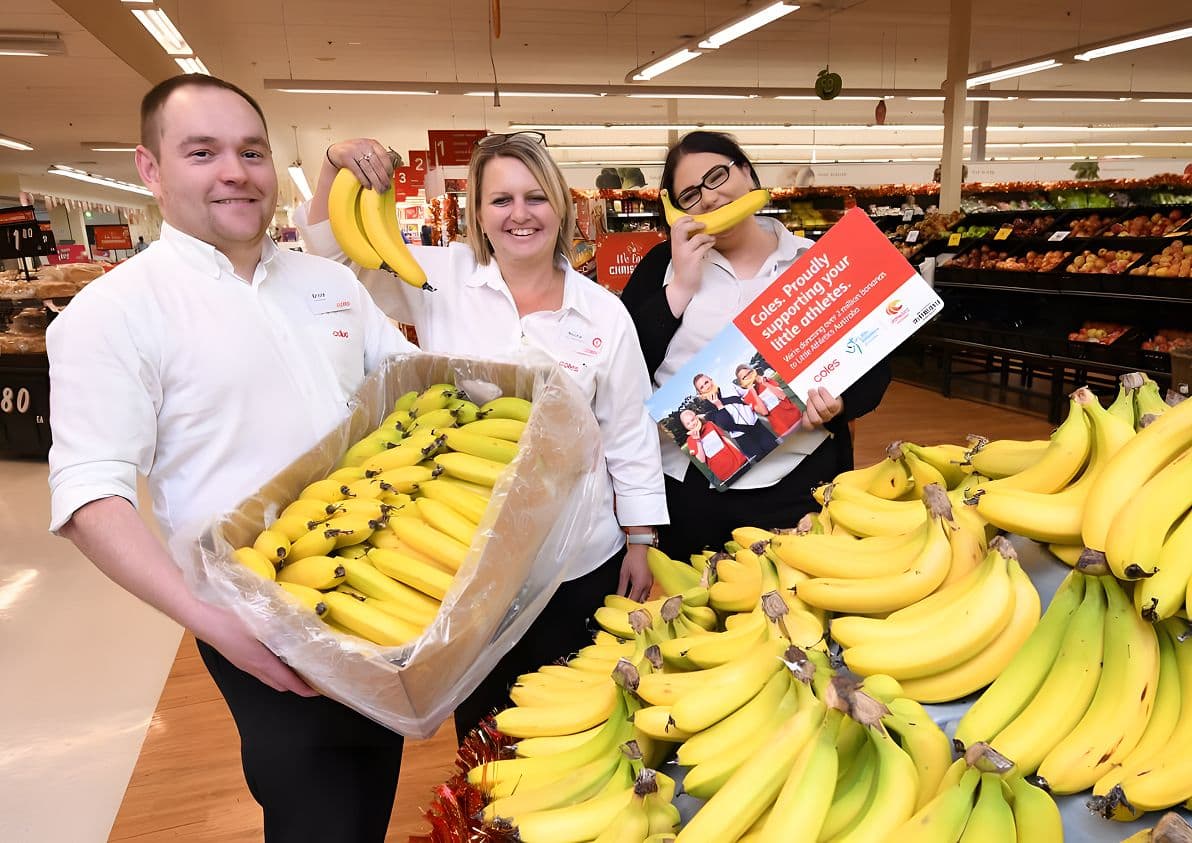
Research focused on observing in-store replenishment behaviours and understanding operational constraints, reach, load height, stock flow from back-of-house to floor, and cleaning routines. Materials were benchmarked for hygiene performance, impact resistance, finish longevity, and suitability for a wet-clean environment. The goal was to reduce bruising while keeping replenishment and cleaning simple for store staff.
Research
In-store observation · Replenishment flow and load height constraints

The process moved from in-store observation and material benchmarking through SolidWorks CAD development, multiple prototype rounds, a formal in-store pilot, and offshore manufacture, with each phase directly informing the next. The 6-month pilot at Coles Brighton was the critical validation gate before committing to national production.
01
CAD Development
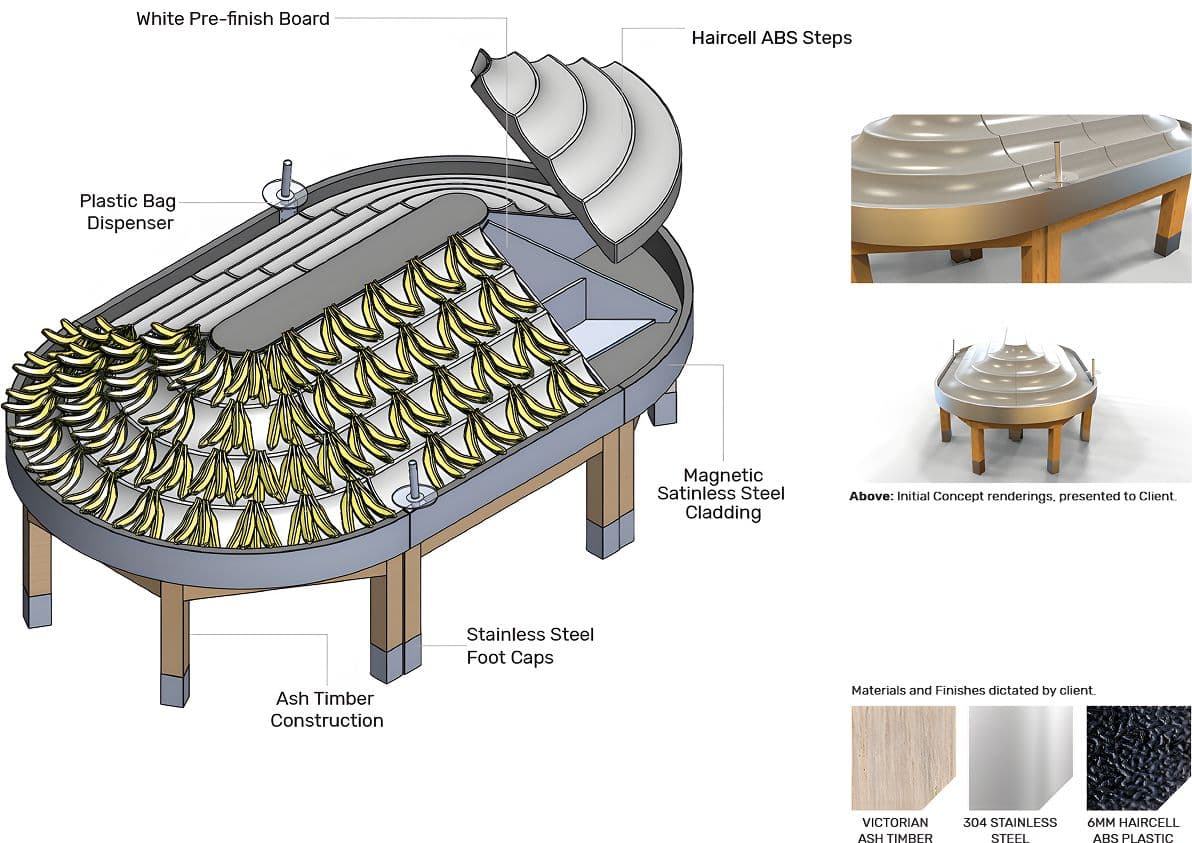
Full 3D definition, joint detailing, and bill of materials developed in SolidWorks. Stepped geometry established early to maximise display capacity and visibility while keeping the form manufacturable at scale.
02
Prototyping
Multiple prototype rounds refining edge treatments, contact surface radii, and module interfaces, each iteration focused on reducing pressure points that cause bruising during loading and replenishment.
03
In-Store Pilot
6-month trial at Coles Brighton validated capacity, replenishment flow, cleaning ease, and damage reduction in a live retail environment. Findings confirmed the design was ready for national production.
04
Manufacturing & Rollout
Offshore production managed through fabrication partners, with national deployment across 500+ Coles supermarkets. Modular construction simplified logistics, flat-pack transport and in-store assembly without specialist trades.
Process
SolidWorks assembly · Exploded view showing module interfaces and joinery
Pilot Location
Coles Brighton
Duration
6 months
Outcome
National rollout, 500+ stores
Pilot Findings
Validated on-floor capacity increase, replenishment ease, cleaning performance, and damage reduction. Edge refinements from prototype rounds confirmed effective in live conditions.

The Banana Barge is a stepped, oval-form display fixture in three modular sizes, built from Victorian Ash timber, 304 stainless steel, and 6mm Haircell ABS. Stepped geometry increases on-floor capacity and product visibility; smooth contact surfaces and careful edge radii minimise bruising; modular construction adapts to any store footprint and simplifies transport and installation.
Stepped Geometry
Tiered display surface increases on-floor stock capacity and product visibility while keeping the fixture accessible for both shoppers and staff during replenishment.
Modular Construction
Three size variants, Small, Medium, Large, built from the same modular components. Flat-pack transport, straightforward in-store assembly, and easy replacement of individual panels.
Material Selection
Victorian Ash for structural warmth, 304 stainless steel for hygiene durability, 6mm Haircell ABS for thermoformed contact surfaces. All materials selected for wet-clean compatibility and long retail lifespan.
Shopper Convenience
Integrated plastic bag dispenser positioned at the natural reach point, a small detail that removes friction at the moment of purchase and reduces loose bags accumulating on the fixture.
Solution
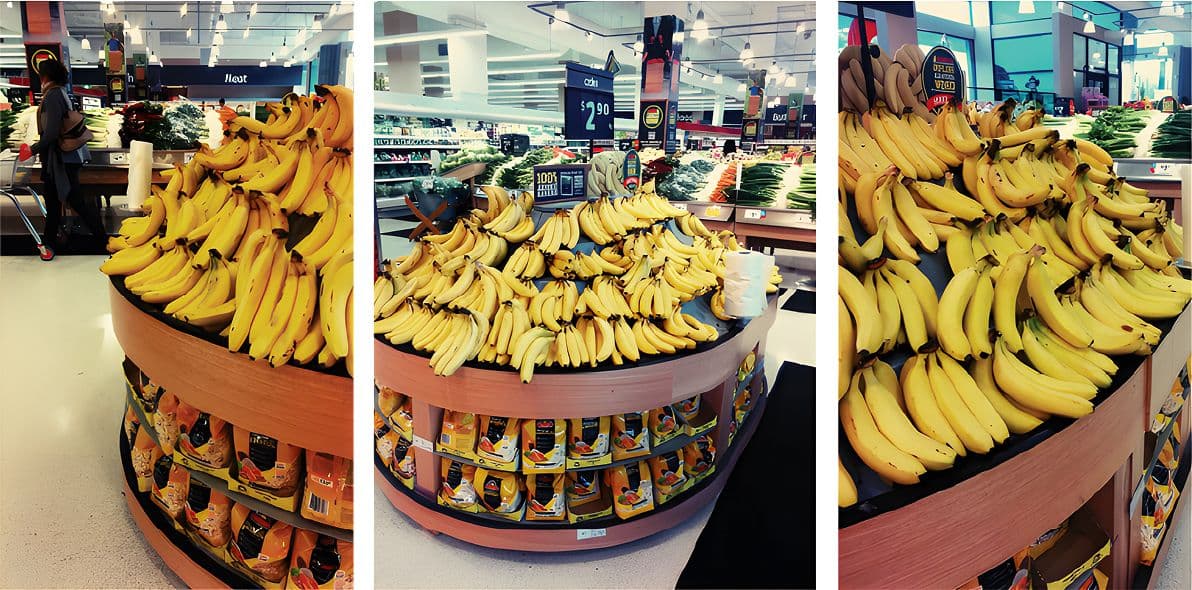
Banana Barge installed at Coles Brighton · Modular oval form with stepped ABS display surface

The Banana Barge was deployed nationally across 500+ Coles supermarkets following the successful Coles Brighton pilot. Still in use 10+ years after initial rollout, a strong indicator of durability, operational fit, and store team adoption. Directional feedback indicated improved display capacity and reduced damage, though no metrics were published.

Key Outcome
Deployed across 500+ Coles supermarkets nationally and still in use 10+ years later, a fixture that outlasted the brief and became a long-term operational standard.
Client
Coles Supermarkets
Via
iCreate Retail Solutions Pty. Ltd.

This project reinforced how small geometry and material choices directly influence product preservation and store workflows, details that are invisible to shoppers but critical to the people using the fixture every day. The 6-month pilot was the most valuable part of the process: it surfaced edge cases that no amount of CAD modelling could predict, and gave the design real-world validation before the cost of national production was committed. It also strengthened my end-to-end confidence across CAD, prototyping, pilot, and offshore manufacture, a path I've applied to every physical project since.